THE LAND QUESTION / IDEAS FOR DISCUSSION
Available lots.
Visible opportunities.
A fair way in.
What could cities and land banks do to move suitable vacant land toward lasting resident homeownership?
FIRST, MAKE THE OPPORTUNITY UNDERSTANDABLE.
A list is a start.
A clear pathway is better.
Show the lot. Explain the conditions. Let people see how a home could become possible.
Proposed lot information would include the seller, sale status, dimensions, zoning questions, access, utilities and any known constraints. A map of land-bank holdings is not the same thing as a list of available building lots. Some parcels may suit a side yard, shared green space or assembly with neighboring land rather than a new house.
Know what is
actually for sale.
Build on existing city and land-bank sale processes. Publish prices or offer instructions, deadlines and selection conditions in plain language. Explain when a buyer must show a credible plan and readiness to complete it.
Existing reference: the Albany County Land Bank publishes a monthly for-sale list and application cycle. It does not make every parcel on its holdings map available.
Read the official sale process ↗Compare more
than the price.
Discuss competitive redevelopment bids or auctions where the seller has authority to use them. A high bid alone does not prove that someone will build a suitable home or live there.
Could published criteria consider completion capability, proposed homeownership, neighborhood fit and safeguards against land speculation? Which sales require a different process? Those are questions for the city or land bank—not rules this proposal claims to establish.
A fair chance
to put down roots.
A drawing for the opportunity to buy a vacant lot at a published price. The lottery concerns land only, not houses.
A selected applicant would have the opportunity to complete the purchase of a specified vacant parcel. Before a lot purchase closes, a selected applicant should explore a credible builder or supported construction and financing pathway, site constraints and necessary approvals. Building the house remains a separate step. Selection would not award a finished home, pay construction costs or grant permission to build.
Possible lot-sale conditions could address a construction deadline and, after the home is completed and occupied, five to seven years of primary residence and reasonable upkeep. Preserve longer program requirements, safeguards against quick resale and fair treatment of hardship. Ask how applicants could understand site constraints and construction-readiness expectations before committing money to a lot.
PROPOSAL ONLY. No Albany lot lottery has been verified or opened here. Legal authority, fair access, funding conditions and selection rules would need review. No entry fee, application or drawing is offered by this website.
MAKE THE IDEA CONCRETE
Four lots.
More than one possible future.
137–143 Third Avenue, Albany: a saved example to discuss, not an approved development.
25′137
THIRD AVE100′ nominal depth
25′139
THIRD AVE100′ nominal depth
25′141
THIRD AVE100′ nominal depth
25′143
THIRD AVE100′ nominal depth
The saved October 2026 Land Bank list described four nominal 25-by-100-foot lots as a $60,000 package. That is a historical asking price, not a development budget or confirmation that the lots remain available.
One owner idea is a duplex on each lot. Single-family homes, triplexes or a different arrangement could be compared instead. The diagram shows parcel relationships only; setbacks, title, access, utilities and actual building fit remain unverified.
Saved parcel references: 137 / 76.56-4-58; 139 / 76.56-4-57; 141 / 76.56-4-56; 143 / 76.56-4-55. Source: saved October list, page 2 of 2. Not a measured survey.
EXISTING PROGRAM ≠ AUTOMATIC BUILDING LOT
Learn from what is already there.
The Land Bank’s “Lots for Less” page describes selected $100 lots with eligibility and use conditions. On October 18, 2026, it stated that no lots were participating. Purchasing a parcel does not guarantee approval to build a home.
Check the official program and current availability ↗MUNICIPAL COORDINATION / SITE READINESS
Prepare the lot. Connect the city.
Assess, clear and prepare
Compare rehabilitation with demolition where appropriate. Assess structures, debris, soil conditions and environmental concerns before choosing work. Consider tree assessment, removal where justified, cleanup, remediation, grading and foundations. The proposal does not assume every tree should be removed or every old house demolished.
Coordinate streets and services
Municipalities, utility providers and qualified contractors could coordinate water, sewer, electricity and any lawful fuel-service needs, including relocation where required. Clarify responsibilities, schedules and resources. This could create local work or training opportunities, but no municipal funding or new jobs are guaranteed.
Make modular delivery possible
Assess truck routes, turning space, staging areas, overhead wires, crane setup and ground support, street access and neighboring-property protection before selecting a modular plan. A small building footprint alone does not establish that modules can be delivered or lifted safely.
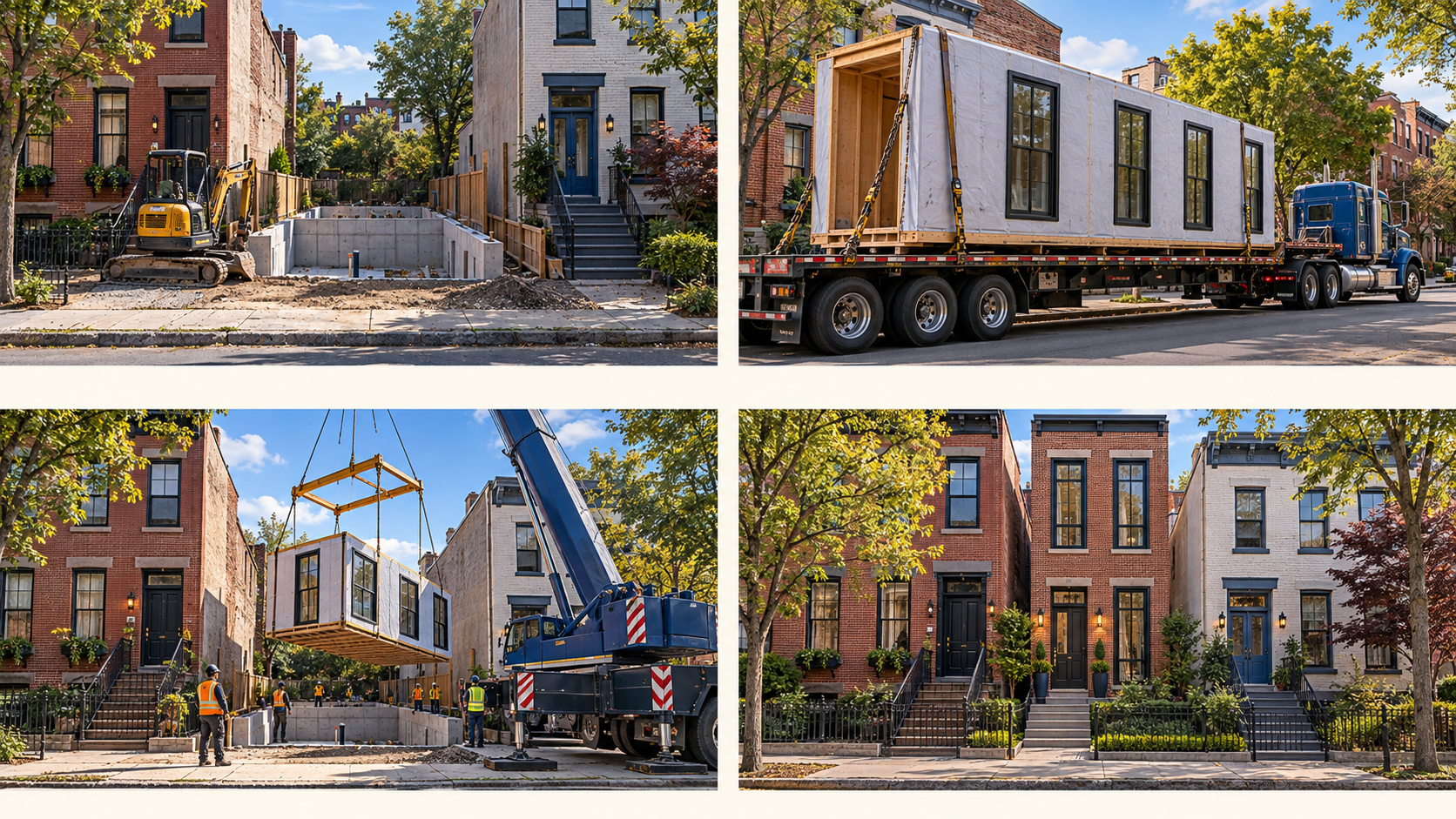
AI-generated architectural construction concept. Not actual project photographs or an engineered lift plan.
See real truck and crane photographs ↗PRIVATE REVISED IDEAS
A vacant-lot lottery to explore.
A proposed drawing for the opportunity to BUY VACANT LAND ONLY. A completed house is not the prize.
Publish the opportunity and test demand
Publish selected vacant lots, prices and proposed owner-occupant criteria. This discussion is intended to help people seeking stable resident ownership, including renters exploring ownership, while respecting existing neighbors. Compare a drawing when qualified demand exceeds supply.
Keep selection fair
Discuss consistent screening, one entry per household, transparent selection and a waitlist. Review fair-housing, accessibility and funding requirements. No local preference or selection rule is adopted here.
Establish a supported build path before closing
A selected buyer could explore a qualified builder, nonprofit-supported route or another credible construction and financing pathway before committing to the lot. A conditional opportunity could allow due diligence. Selection does not fund a house or approve plans.
Protect the purpose through completion
Discuss recorded occupancy and resale safeguards that carry through transfers, with lawful enforcement, lender rights and fair hardship treatment. Explore checks against nominee buyers used to evade resident ownership. Discuss five to seven years of primary residence without shortening longer program terms.
IDEAS FOR DISCUSSION / OCTOBER 18 REVIEW
Prepare the lot. Connect the city.
A parcel-readiness sheet could make land and infrastructure questions easier to discuss.
Record what is known about the property
Bring together seller and sale status, title questions, dimensions, intended use, access and known constraints. Compare rehabilitation with demolition. Consider debris, soil, possible lead/asbestos, tree assessment and remediation where justified. A listed parcel is not automatically a buildable lot.
Coordinate services and responsibilities
Municipalities, utility providers and qualified contractors could examine water, sewer, electricity and any lawful fuel-service needs, including relocation where required. Ask whether adjacent sites could be coordinated. Identify responsibilities, timing and resources without promising municipal funding, savings or new jobs.
Check delivery before choosing a system
For modular options, assess truck routes, turning space, staging, overhead wires, crane setup and ground support, street access and neighboring-property protection. Compare these constraints with other construction methods. The readiness sheet would inform feedback, not replace engineering or permits.
PRIVATE REVISED IDEAS
One package. Several owner paths.
Suggestions for land banks, municipalities and willing development or community partners.
Find a lawful route to the land
Distinguish city-owned land, land-bank holdings, willing private sellers, tax-foreclosed property and unclear ownership. Establish ownership and sale authority. A derelict building needs proper assessment and process; its condition does not make the land available.
Bridge the package with outside support
A willing nonprofit or developer could secure a four-lot package, seek acquisition and site-preparation support, and arrange separate homeowner purchases where feasible. Ask how occupancy and resale protections would carry through every transfer and how final pricing would be explained. Habitat is an example to invite, not a committed partner.
Offer lots with a credible route forward
A municipality or land bank could explore a drawing for eligible vacant lots. A nonprofit could instead acquire a package and arrange separate homeowner sales under applicable requirements. If it chose a drawing for those lots, that would need its own lawful, published process. These are alternative routes, not one required sequence.
Connect energy and household needs
Consider NYSERDA and other suitable energy assistance alongside repair or construction. Check eligibility separately: an existing-home incentive is not automatically new-build funding. Grants, loans, local work and training remain possibilities, not awards or guaranteed savings.
What was checked, and when
The saved October 2026 sales-list details were reviewed on October 18. That is a review of the saved document, not fresh confirmation from the seller that the lots are available. Confirm current availability, title and dimensions before relying on this example.